
Check the make-down capacity
Record the expected product demand, preparation-water availability, tank working volume and operating schedule. The dry feeder’s maximum throughput does not establish the volume of consistently prepared solution available to the dosing point.
Confirm the supplied instructions for the proposed powder. Review wetting, mixing and maturation as separate parts of the preparation process. Avoid assuming that another grade’s concentration or preparation time applies unchanged.
Look for uniform dispersion
Inspect how particles enter the water. A concentrated pile at the surface or damp material in a feeder may produce uneven preparation. Partly hydrated agglomerates can make delivery inconsistent even when the nominal dry mass is correct.
The powder-lump diagnosis distinguishes a wetting problem from a product-performance question. Do not compensate for visibly inconsistent stock by changing process dose without first identifying the cause.
Approve the solution on actual feed
Prepare a controlled sample and compare the intended separation outcome. For settling, observe liquid quality and bed behavior; for filtration, include drainage and handling. A smooth-looking stock is necessary evidence of preparation consistency but is not application approval.
Record the measured dose and its units. Keep commercial-product mass distinct from active-polymer mass. The active-content comparison explains why a solids figure should not silently become a dose-conversion factor.
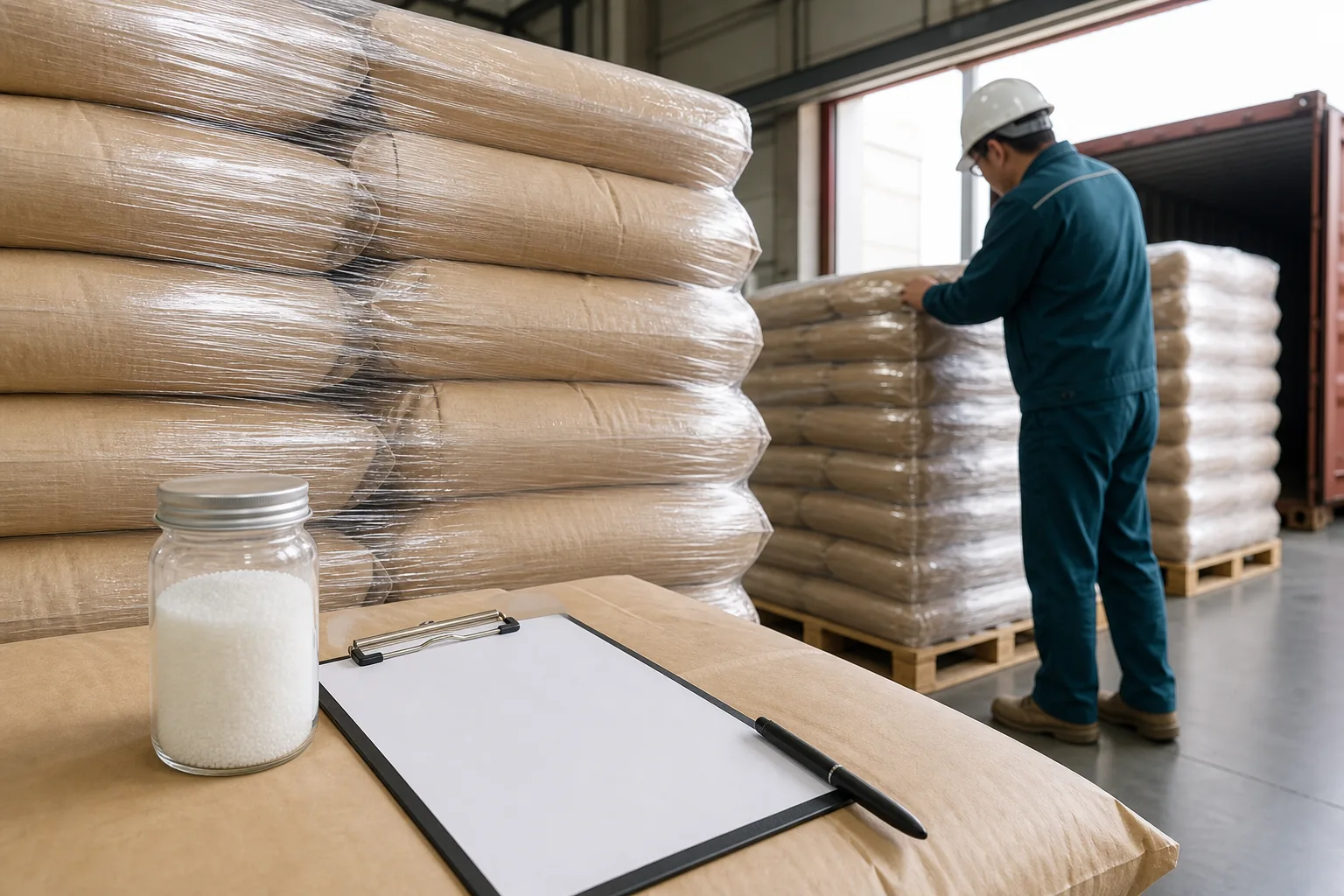
Specify storage and receipt requirements
Request the current SDS, storage guidance, packaging proposal and lot identification. Confirm how partly used packages should be closed and managed at the plant. Product-specific instructions take precedence over generic storage assumptions.
Tie the purchase to the selected code and agreed release specification. Review supply documentation before confirming a quotation, and preserve the sample record for comparison when commercial material arrives.
Resolve the purchase requirements
Use Buying NPAM Powder: Check Make-Down Capacity Before Ordering, Bulk Nonionic Polyacrylamide Packaging: Choosing an Order Size, Nonionic Polyacrylamide Powder vs Liquid: Comparing Supply Forms to connect the process requirement with the proposed supply. Confirm the product code and unresolved acceptance questions before committing to the order.