
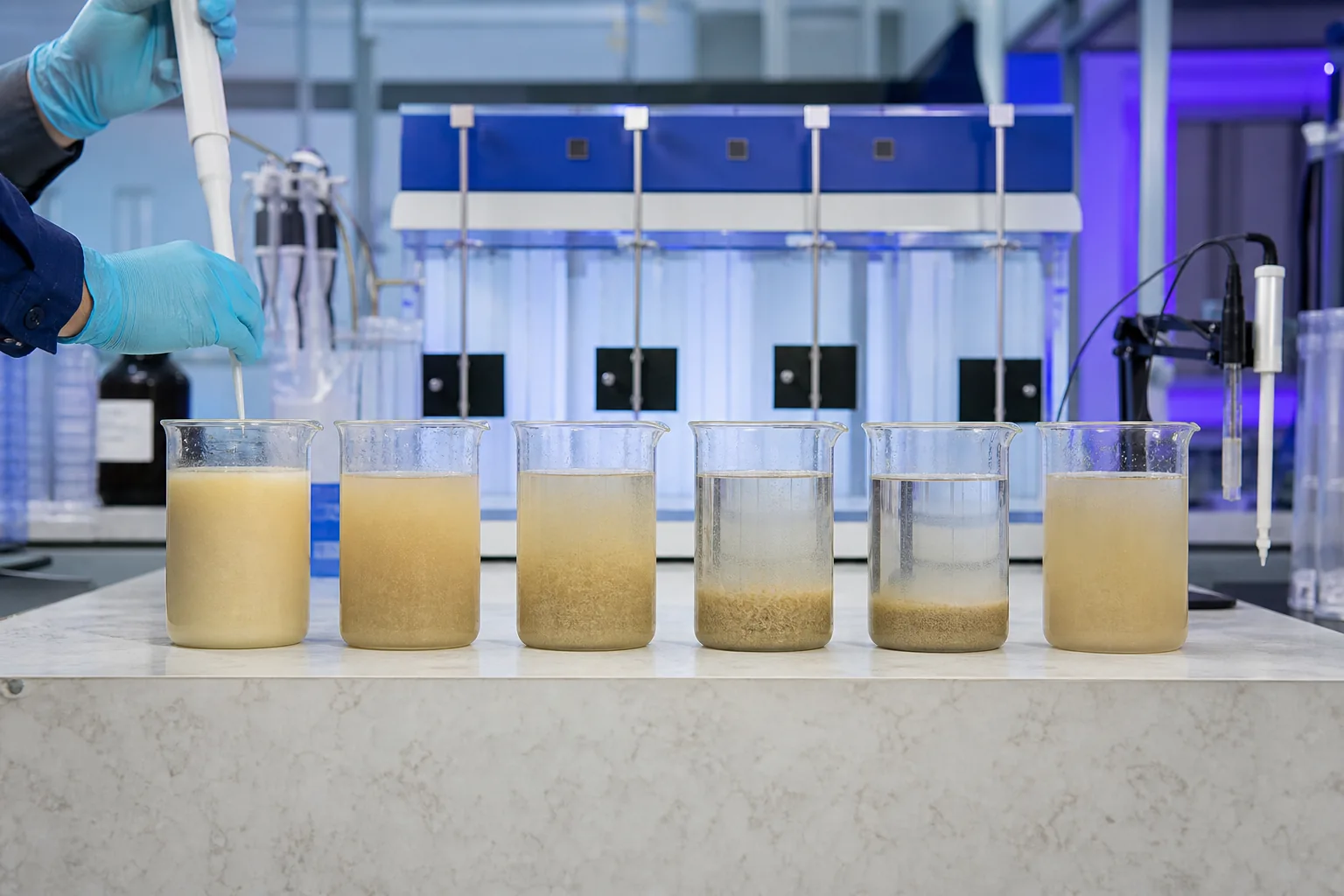
Ask for the definition and method
A solids-content result describes a property measured by a specified method. It should not automatically be treated as the fraction of active polymer available for an application calculation. Ask the supplier which value is appropriate and how it is established.
Keep the relevant method, units and document revision with the sample code. If the active basis is unavailable, compare measured commercial-product consumption explicitly rather than creating an unsupported conversion.
Keep three quantities separate
Commercial-product dose is the mass of supplied material added per treatment unit. Active-polymer dose uses a documented active fraction. Prepared-stock concentration describes how much product or active material is present in a stated mass or volume of solution.
Label the basis each time. A stock concentration stated as mass per volume needs the relevant units; a mass fraction is a different definition. Do not silently change between them because the numerical values look convenient.
Use one transparent calculation
Where an appropriate active mass fraction is confirmed, active mass equals commercial-product mass multiplied by that fraction. Conversely, the commercial mass needed for a defined active mass is the active mass divided by the fraction. The fraction must come from documented product information, not an assumed equivalence with another property.
For an actual plant comparison, measured commercial consumption may be the clearest starting point. Keep the separation result and feed condition alongside it. A mathematically correct normalization does not establish that two grades perform equivalently.
Carry the basis into the enquiry
Supply the product code, dose units and how stock was prepared. Mark any unconfirmed analytical basis as unresolved. Ask for clarification before using the figure to set an acceptance criterion or a treatment-cost comparison.
Use the NPAM trial plan for a consistent comparison and the supply-document review to resolve specification questions. Product approval should combine a clear calculation basis with the measured operating outcome.
Carry the operating evidence into the purchase
When the observed condition affects a supply decision, compare Nonionic Polyacrylamide Price per Ton: Compare Qualified Offers, Nonionic Polyacrylamide Powder vs Liquid: Comparing Supply Forms, Nonionic Polyacrylamide COA and Batch Acceptance Checks. Retain the identified sample and the measured operating condition with the quotation so the approved material can be traced into the commercial order.