
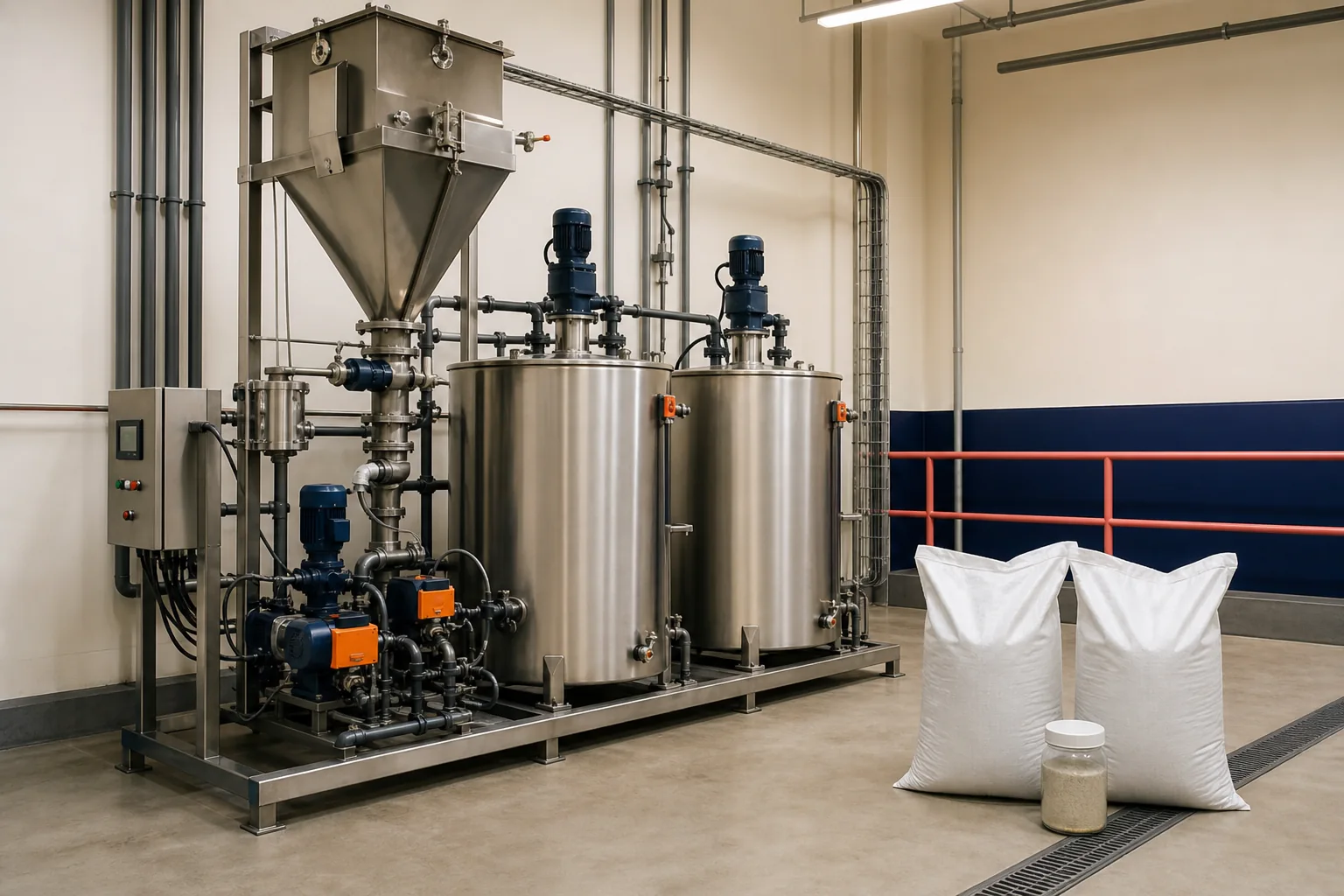
Observe where the agglomerates appear
Check whether lumps are present in the dry package, at the water-entry point or only after transfer into a preparation tank. These observations distinguish storage, dispersion and downstream handling questions. Record the material code and when the condition began.
A damp or compacted powder should be reviewed against its handling instructions before use. Newly formed gel-like agglomerates may instead indicate that particles entered the water together and were not dispersed uniformly.
Review powder entry before changing mixing
Compare the feed rate with the wetting arrangement and available water flow. A local pile of particles can wet unevenly even when total tank water is adequate. Observe whether the feeder delivers a consistent stream or intermittent slugs.
Do not treat more agitation as a universal solution. Dispersion and subsequent hydration have different objectives, and equipment changes should follow the product instructions and plant procedures. Check the actual preparation sequence rather than relying only on the control-panel setting.
Keep concentration and time visible
Record the intended and measured preparation quantities. A weighing error, wrong working volume or shortened maturation period can make a previously stable recipe inconsistent. Compare preparation water and temperature with the conditions used during qualification.
Use a controlled fresh preparation to assess whether the problem persists. Avoid silently filtering out lumps and treating the nominal powder dose as fully available polymer; that can obscure both product loss and the true application comparison.
Retest the process only after stock is consistent
When preparation becomes repeatable, compare treatment response at stated dose units. If separation still fails, investigate grade suitability and the feed condition as a separate question. Keep photographs and the preparation record with the sample code.
Review powder handling requirements and make-down water controls before requesting a replacement candidate. For damaged material or spills, use the specific SDS and the plant’s approved handling process.
Carry the operating evidence into the purchase
When the observed condition affects a supply decision, compare Buying NPAM Powder: Check Make-Down Capacity Before Ordering, Bulk Nonionic Polyacrylamide Packaging: Choosing an Order Size, Ordering Nonionic Polyacrylamide Samples Before a Bulk Purchase. Retain the identified sample and the measured operating condition with the quotation so the approved material can be traced into the commercial order.